G&A Institute and Ceres released joint research examining the first voluntary corporate reports on climate risk submitted under California's Climate-Related Financial Risk Act (SB 261).
We aim to promote equal opportunities by inspiring underrepresented groups to take up STEM fields by exposing them to aviation employment options and opportunities. By fueling the pipeline today through our support of educational initiatives and STEM programs, we will help to ensure more diverse perspectives in the hangars and boardrooms of the future.
“Sustainability is about the actions we take to fulfil our purpose so Landsec prospers far into the future. We want customers to prefer our spaces. We want communities to be pleased it’s us operating in their area. We want partners to share our priorities. And we want employees to invest their energy and ambition here. When we get all this right, we create value for our investors.” Robert Noel, Chief Executive, Landsec
To better understand current climate-related financial disclosure practices and how they have evolved, the Task Force on Climate-related Financial Disclosures (TCFD or Task Force) reviewed—using artificial intelligence technology—reports for over 1,000 large companies in multiple sectors and regions over a three-year period. In addition, the Task Force conducted a survey on companies’ efforts to implement the TCFD recommendations as well as users’ views on the usefulness of climate-related financial disclosures for decision-making.
he Task Force on Climate-related Financial Disclosures (TCFD) published its 2019 Status Report to the Financial Stability Board (FSB) today. The TCFD’s second status report provides an overview of disclosure practices aligned with the Task Force’s recommendations between 2016 and 2018.
Johnson & Johnson (NYSE: JNJ), the world’s largest and most broadly-based healthcare company, today released its Health for Humanity Report detailing the Company’s annual progress in its environmental, social and governance (ESG) focus areas: advancing better health for all, investing in our people, maintaining responsible business practices, and safeguarding the environment.
Water and energy systems long have been intrinsically intertwined, given electricity's entrenchment as one of a water or wastewater utility's biggest expenditures. But as water suppliers and wastewater service providers grapple with ways to reduce power costs, advance toward "green" energy and participate in the electric industry evolution, there's talk of "ner energy."
In the water industry, data is driving the discussion. To understand what this means requires a story about motor oil.
For decades, car manufacturers recommended that vehicles have their engine oil changed at least every 3,000 miles without fail. This was never proven practical, given that such decisions should be based on individual driving style, the conditions and climate – even the type of oil used. But these real-world conditions don't tend to factor into the carmaker's original guidelines.
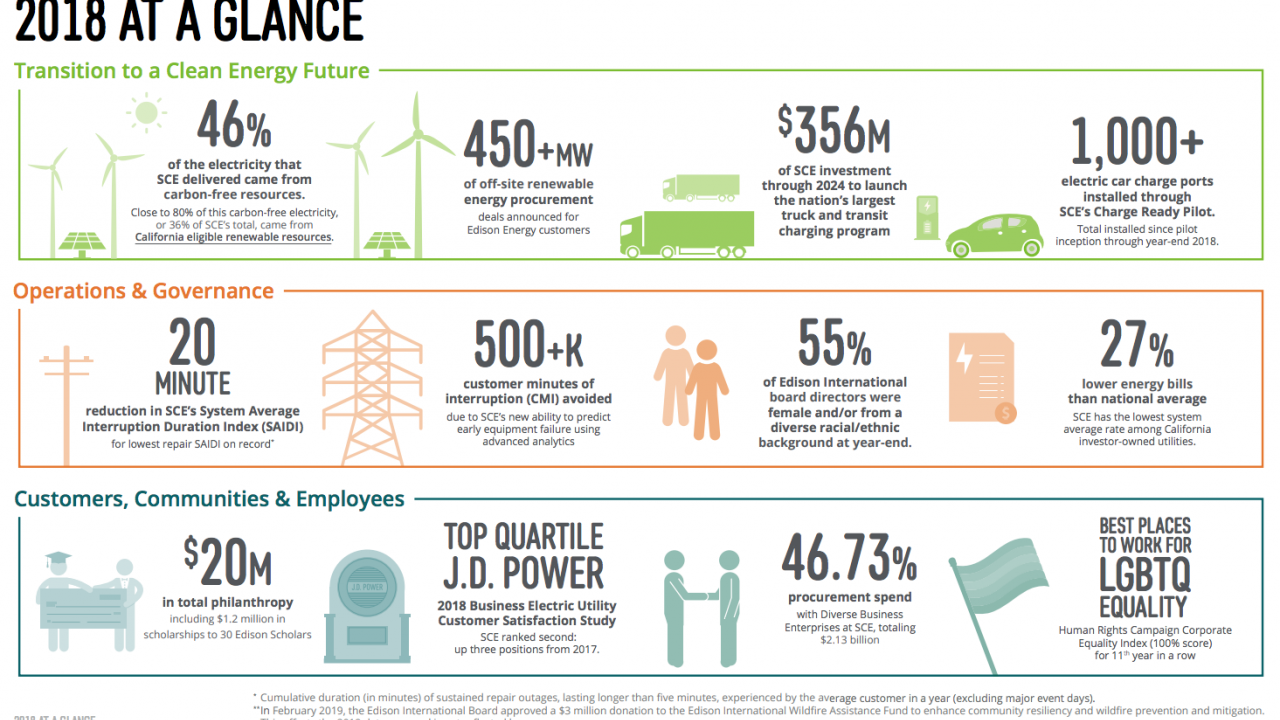
Edison International has released its 2018 Sustainability Report reflecting its sustainability strategy and 2018 sustainability performance. The report shows how the company is leading the transformation of the electric power industry and operating its business with excellence by focusing on customers, communities and employees, with safety as its top value.
Our long-standing commitment to environmental leadership helps us achieve efficiency, reduce costs, and respond to the needs of our customers and community stakeholders. We invest in conservation projects and set company-wide environmental targets, seeking to drive reductions in greenhouse gas emissions, energy use, water use, and waste generation. We also work with others to apply Intel® technology to environmental challenges such as climate change and water conservation.
In 2018, Cape Town residents stared down "Day Zero," the moment when the water system – jeopardized by the combination of population growth, drought cycles, aging infrastructure and deferred system improvements – was predicted to literally run dry. Fortunately, citizens rallied by heeding the conservation calls, and the skies opened. A historic crisis was averted for its more than 3 million residents. But the lessons lingers on: Government and water industry leaders the world over are reconsidering how climate impacts and deferred maintenance threaten the resilience of our supply.
The SCS Kingfisher certification mark is showing up on an increasing number of products around the world. It differentiates companies that are making...
Cascale organizes and participates in a series of events, leveraging its position as a global convener of close to half the sector to bring together...
At Marathon Petroleum, our professional truck drivers share one common vision: no accidents, no injuries, and no harm to the environment. We’re proud...
GoDaddy, the world’s largest domain name registrar, helps millions of entrepreneurs globally start, grow, and scale their businesses. People come to...
Environmental Responsibility: We’ve achieved 14 out of 16 of the environmental goals we set in 2010, and we will accelerate our progress as we work to...
We are accelerating our efforts to help build a low-carbon economy and avert the worst impacts of climate change. Our goal to reduce our GHG emissions...
Join us as we travel the world to uncover real stories of impact—from landfills and energy transition to workplace safety, emerging contaminants, and...